

The 1,400km Survival Test: Professional Packing vs. DIY for Long-Distance Moves
When reviewing a relocation quote, many homeowners view packing services as an optional luxury—a simple convenience fee to avoid spending an afternoon assembling cardboard boxes. This mindset is one of the costliest mistakes you can make when moving across South Africa.
Packing is not merely about boxing up items to make them easier to carry. It is an engineering challenge. When a vehicle loaded with household goods travels 1,400 kilometers along the N1 between Cape Town and Johannesburg, every item inside experiences sustained physical stress. Hours of continuous micro-vibrations, road bumps, emergency braking events, and shifting weight will test the structural integrity of every container on board.
In short: proper packing isn’t an optional add-on; it is the fundamental protection mechanism that determines whether your dining room table, OLED television, or heirloom mirror survives the journey intact. Here is how to evaluate the choice between packing yourself and hiring professionals, and how to implement a strategic “split-pack” model that keeps your budget under control.
The Physics of Transit: What Happens Inside the Truck
To understand why cheap packing fails, consider what occurs inside a long-distance moving vehicle. Unlike a ten-minute drive down a suburban street, a cross-country journey subjects your belongings to dynamic physical forces over many hours:
- Micro-Vibrations: Continuous road contact creates steady high-frequency vibrations that loosen unscrewed table legs, wear away delicate timber finishes, and rub delicate porcelain items together until they shatter.
- Weight Stacking Pressures: To optimize space, boxes are stacked vertically inside the truck. A flimsy single-walled box placed at the bottom of a stack will collapse under the weight of the boxes above it over hours of movement.
- Climatic Shifts: Crossing different geographic provinces exposes cargo to sudden shifts in temperature and humidity, which can warp unprotected solid wood or cause condensation inside unsealed plastic containers.
A standard cardboard box from a local supermarket is designed to hold lightweight groceries for 20 minutes—it is completely unequipped to survive the physical demands of long-haul transit.
The DIY Dilemma: Where Self-Packing Falls Short
Packing your entire household yourself certainly reduces initial line-item costs on a quote, but self-packing carries significant hidden risks that often surface after the truck arrives at your new home.
1. Inferior Materials
Most DIY packers rely on single-walled, second-hand cardboard boxes, thin masking tape, and folded newspaper. Newspaper print transfers carbon ink onto ceramic plates and fabrics, requiring hours of scrubbing after unpacking. Thin box walls buckle under load, and standard stationery tape loses adhesion under temperature variations, causing box bottoms to drop out when lifted.
2. The Insurance “Packed By Owner” Exclusion
This is the most critical clause in the moving industry. Virtually every commercial transit insurance policy explicitly excludes coverage for items inside boxes marked “PBO” (Packed By Owner). If you pack a box of crystal glassware yourself and it arrives at your destination in pieces, the insurance provider will deny the claim on the grounds of non-certified packing. When professional movers execute specialized packing solutions, those items are formally cataloged, sealed, and covered under the carrier’s insurance policy.
3. Improper Weight Distribution
An untrained packer often fills a large box with heavy books, making it dangerously heavy and structural prone to breaking, while putting light pillows in small boxes. Professional packers follow strict weight-to-volume ratios: heavy items in small boxes, lightweight bulk in large boxes.
The “Split-Pack” Strategy: The Smart Middle Ground
You don’t need to choose between an expensive, full-service packing service and doing every single room yourself. The most cost-effective and secure strategy for modern home moves is the Split-Pack Approach.
Under this strategy, you divide your household inventory into two distinct categories: Low-Risk Non-Breakables and High-Risk Valuables.
Category A: What You Should Pack Yourself (DIY)
Save money by taking responsibility for durable, low-value items that cannot be easily crushed or broken during transit:
- Clothing, linen, towels, and bedding.
- Soft toys, cushions, and curtains.
- Books, documents, and non-perishable pantry goods.
- Unbreakable plastic kitchenware and sturdy sports equipment.
Category B: What You Must Leave to the Professionals
Delegate high-value, fragile, or structural items to trained moving professionals who utilize specialized materials:
- Electronics & Displays: Flat-screen televisions and audio monitors require heavy-duty anti-static wrapping and custom double-wall TV cartons.
- Glassware & Ceramics: Plates packed vertically (like vinyl records) in heavy-duty dish-pack cartons using acid-free newsprint paper, never stacked flat.
- Fine Art & Mirrors: Delicate frames, oil paintings, and large mirrors require custom wooden crating or reinforced picture telescope boxes.
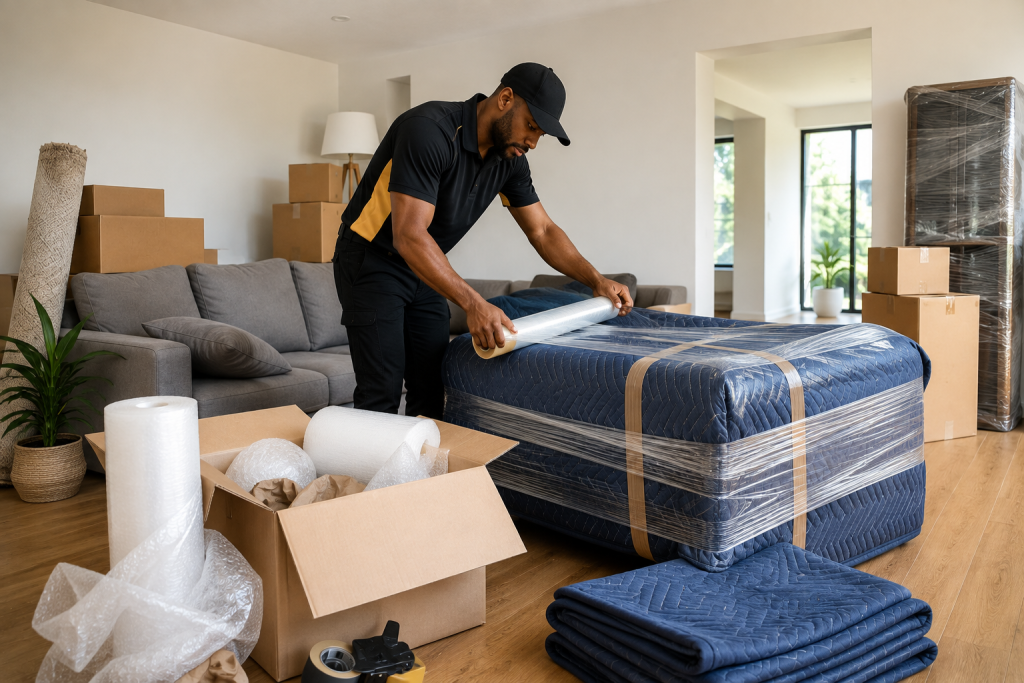
- Polished Timber & Antique Furniture: Polished wood surfaces require multi-layer bubble-wrap or thick padded moving blankets secured with tension stretch-wrap to prevent friction rub during the trip.
Specialist Items and Architectural Bottlenecks
Sometimes, the primary danger to an item isn’t the distance it travels on the highway, but the physical building it has to leave or enter. Large grand pianos, heavy marble table tops, fireproof security safes, and oversized sectional sofas frequently present severe clearance issues in modern apartments and office buildings.
When an item cannot safely turn through tight stairwells or fit inside passenger elevators, forcing it through risks scuffing walls and damaging the asset itself. In these scenarios, professional removal teams deploy specialist services, utilizing heavy-duty external hoisting equipment, rigging straps, and custom wooden crating to lift items safely over balcony rails or external building facades.
Connecting Your Packing to Your Broader Logistics Plan
Your packing strategy directly influences every other stage of your relocation workflow:
- For Long-Distance Moves: Secure, double-walled packing is essential to prevent cargo movement when booking dedicated trucks or shared loads on long distance moving routes.
- For Interim Storage: If your move includes a gap between properties requiring secure storage solutions, professional packing ensures items remain dust-free, protected against ambient moisture, and structurally sound while stacked inside storage vaults.
- For Local Moves: Even for quick trips managed via regional local move services, proper furniture padding prevents minor scuffs when navigating residential entryways.
The Final Verdict: Prioritize Protection Over Luck
A successful relocation isn’t measured by how quickly you load a truck—it’s measured by the condition of your belongings when you unpack them in your new home. By adopting a smart split-pack model, you maintain control over your budget while ensuring your highest-value assets receive the specialized materials, professional handling, and insurance coverage they require to survive the journey.
When planning your next relocation, partner with proven furniture removals specialists in South Africa who offer clear guarantees, modern protective packing materials, and transparent pricing tailored to your specific needs.
