

Specialist Moving Services: How to Safely Transport Pianos, Antiques, and High-Risk Cargo
Most household items—such as dining chairs, boxed clothing, and standard mattresses—are relatively simple to relocate. They fit neatly into rectangular cardboard boxes or stack uniformly inside a carpeted moving truck. However, almost every home or office relocation includes at least one item that breaks all standard rules.
Whether it is an upright piano passed down through generations, an oversized marble dining table, a valuable antique cabinet, or a classic motorcycle, certain belongings demand more than standard manpower and moving blankets. Attempting to move these items with traditional techniques often leads to irreparable damage, severe structural property harm, or personal injury.
This guide breaks down how professional removal teams handle high-risk assets, introduces the 3-Factor Test for identifying specialist items, and explains why modern building architecture is frequently a bigger challenge than the item itself.
The 3-Factor Test: What Makes an Item “Specialist”?
How do you know if an item requires dedicated technical handling rather than standard moving logistics? Professional movers rely on a three-factor evaluation test to categorize cargo:
1. Asymmetric Weight and Center of Gravity
Standard furniture distributes weight evenly. Specialist items, however, often feature extreme weight concentrated in small or offset areas. A cast-iron piano plate, for example, concentrates hundreds of kilograms into a top-heavy frame. Lifting an item with an offset center of gravity without specialized equipment risks sudden tipping and catastrophic drops.
2. High Fragility and Financial or Sentimental Value
Items like oil paintings, antique timber furniture, custom glass panels, and delicate marble slabs possess zero structural flex. A minor twist or vibration during transport that would leave a standard bookshelf unharmed will snap a marble table top or shatter a delicate lacquer finish.
3. Architectural Access Constraints
An item may be structurally sound, but physically impossible to clear through standard doors, stairwell turns, or passenger elevators. When an item’s physical dimensions conflict with a building’s geometry, special access solutions must be deployed.
When the Building Is the Real Problem (Not the Item)
A common misconception is that specialist moving services are only required for bizarre or massive objects. In reality, modern property design is often the primary force behind specialist requirements.
Contemporary apartment complexes and modern office parks prioritize high-density layouts. This frequently results in narrow staircases with sharp 90-degree turns, low-ceiling corridors, tight security turnstiles, and passenger elevators with strict weight capacity limits. A heavy sectional sofa, a solid oak boardroom table, or an executive desk may fit comfortably inside your living room, but proving physically impossible to navigate down three flights of spiraling stairs.
The Solution: Professional Balcony Hoisting and Rigging
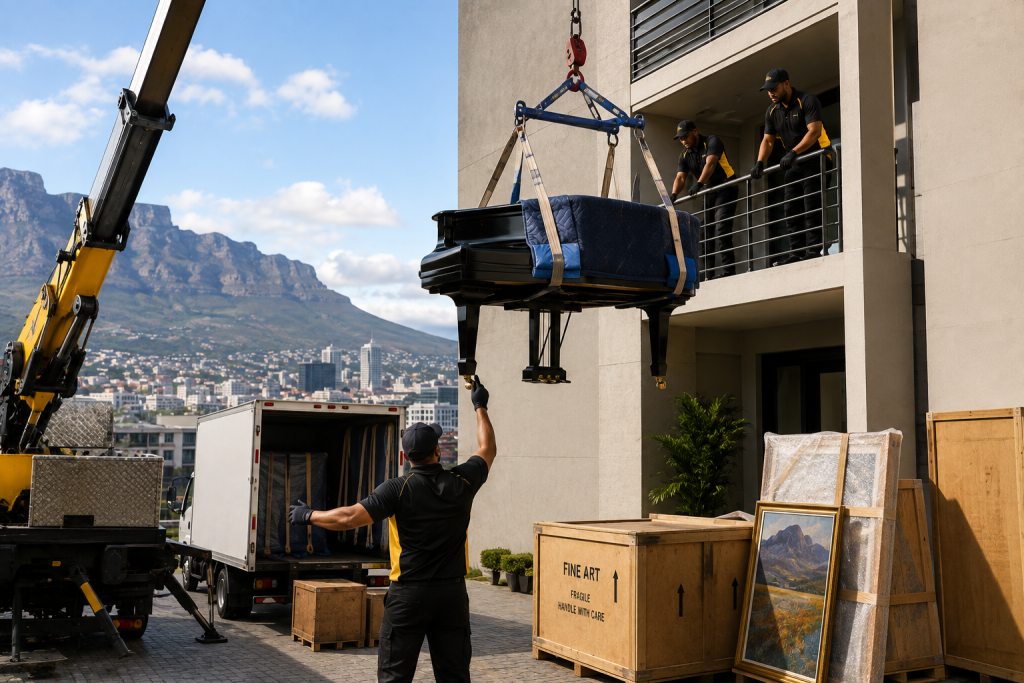
When interior pathways are blocked, the only viable route is through exterior access points. Utilizing balcony hoisting and external rigging allows teams to lift heavy, bulky assets directly from ground level into upper-floor balconies or window openings.
Executing a balcony hoist is a precise engineering task. It requires heavy-duty industrial webbing, high-tensile rigging straps, protective edge guards to prevent balcony masonry damage, and trained ground personnel to control guide ropes. Attempting a DIY hoist with hardware store ropes is a recipe for property destruction. Utilizing certified specialist services ensures that high-altitude lifts are conducted under strict safety protocols.
Handling High-Value Asset Categories
Different specialist items present unique logistical requirements during a relocation. Here is how professional logistics teams protect specific high-risk categories:
Pianos (Upright and Grand)
Pianos are both heavy machinery and delicate musical instruments. An upright piano weighs between 180kg and 400kg, while a grand piano can exceed 500kg. Inside, thousands of precision wooden and felt parts are held under immense string tension.
Moving a grand piano requires removing the legs and lyre, securing the keybed to a specialized, padded piano shoe (board), and wrapping the body in heavy-duty protective padding. Specialized heavy-duty piano trolleys are used to navigate flat surfaces, while stair-climbing apparatus or hoisting gear is deployed for elevation changes.
Antiques and Fine Artwork
Antique furniture lacks modern fasteners and composite strength; aged timber joints dry out over decades, making them vulnerable to structural twisting. Furthermore, oil paintings and glass-covered artwork require protection against both physical impact and atmospheric moisture.
Protecting these assets requires custom-tailored preparation. Instead of standard tape or bubble wrap, fine art requires acid-free glassine paper coatings to protect paint surfaces, followed by bespoke double-walled crating. Pairing custom timber crates with tailored packing and crating solutions creates a rigid protective shell that shields fragile surfaces throughout transit.
Motorcycles and Recreational Vehicles
Transporting a motorcycle inside a moving truck alongside household furniture requires specialized tie-down infrastructure. Motorcycles cannot simply be rested on their kickstands, as road vibrations will knock them over.
Professional movers utilize dedicated front-wheel chocks to lock the front tire in place, combined with heavy-duty soft-loop ratchet straps attached to floor-mounted D-rings. This suspends the motorcycle’s weight on its own suspension, absorbing road shocks along the journey without putting pressure on fairings or handlebars.
Integrating Specialist Services Into Your Broad Logistics Strategy
Specialist handling does not happen in isolation—it must be seamlessly integrated into your overall relocation plan:
- Long-Distance Relocations: High-risk assets traveling cross-country require rigid internal securing to withstand hours of road movement on long distance moving routes.
- Interim Depot Storage: If your new property isn’t ready immediately, specialized items like pianos or antiques must be held in secure, climate-stable environments within vaulted storage solutions to prevent humidity damage.
- Local Metropolitan Transfers: Even short regional transfers handled via local move services require pre-move access audits to identify balcony hoisting needs before the truck arrives.
The Gold Standard: Professional Accountability
When trusting a logistics partner with your most valuable, fragile, or sentimental possessions, verbal promises are insufficient. Always select a provider offering transparent operational protocols and clear money-back performance guarantees across their South African furniture removals network.
By identifying specialist items early, evaluating architectural building bottlenecks, and deploying specialized equipment, you eliminate moving day panic and ensure your most prized possessions arrive safely at their new home.
